It’s New Radio Day!

Woohoo! It’s always an adventure to un-box a new radio. In this case it’s “new to me”, but qualifies as “vintage” or “classic”, I guess. I picked up a Yaesu FT-1000MP, manufactured in 2000 – so, 26 years old. That makes it a late production 1000MP, made just as the successor FT-1000MP MKV was introduced. This was Yaesu’s flagship HF contesting rig at the time, retailing for $2500 at the time – which would be just a bit under $5000 in 2026 dollars. It was pretty advanced for the time, with dual receivers, DSP in the audio chain, and quadruple conversion. These were a huge hit with contesters, and the price on the used market has fallen well under $1K for a clean example with no defects.

The radio arrived yesterday from a ham in Wisconsin. I unboxed it and gave it a quick bench checkout to make sure there were no major issues. Aside from a little dent in teh top speaker grille – easily corrected once I have the top cover off – there are no cosmetic issues with it. The display isn’t quite as bright as I’d like to see, but it’s adequate; these old CCFL backlit LCDs are aging out and will all eventually fail. Fortunately, replacing the backlight with an LED strip is neither difficult nor expensive. I did it to my TS-850 last year.

After setting it up on the operating desk, I did some side by side comparisons with the Kenwood. Both seem to have about the same sensitivity; I could copy both stronger and weak signals on both rigs with essentially identical readability. That shouldn’t have been a surprise, really — the TS-850 was no slouch for its day, either. I switched both rigs to the 500 Hz CW filters. The Kenwood’s is an optional crystal filter I had to buy and install, the Yaesu has one installed in the second IF (8.215 MHz) from the factory. It was pretty obvious that the FT-1000MP was a little better – again, both were clear and readable, but there was a little less noise on the Yaesu, and it was less tiring to listen to. Later I figured out that I didn’t have the audio DSP switched on at the time; that makes it sound even better.

I’ve spent a little time exploring how to use the rig. It will take a while to learn all of the features and functions, but there are already a coupe that surprised me. It doesn’t surprise me that there is a sub-receiver, obviously. I figured that was handy for contesting, but didn’t really see how I’d use it during casual operating. I was surprised, however, by how quickly I figured out that yes, it is nice to be able to tune around listening for other stations without changing your operating frequency. It’s so quick and easy to just hit the “dual” button to get both receivers in the headphones.

Tuning the RT-11 remote tuner is pretty quick and easy… though it will be even quicker and easier when I have a remote keypad plugged in (Yaesu FH-1 or FH-2 or equivalent). That has a dedicated button to put out a carrier at a selectable 10, 25, or 100W power level for just this purpose. For now, I turn off the internal tuner and the keyer, set the RF power control to about 12 o’clock, and key the rig with either paddle. That puts about 25W out to the antenna. When the RT-11 finishes I turn on the rig’s tuner, hit the TUNE button, and while it’s doing its thing turn the RF to max and turn the internal keyer back on. The whole process takes only a few seconds.

So far the only glitch I’ve found is a non-working “A->B” button. This is the one that copies the main VFO frequency to the sub VFO. I do miss that function and I’ll need to fix that button. I’m hopeful that Yaesu used standard tactile switches for the panel and not some dome switch pad. Over the next few days I have some things planned that will require taking the overs off, so I’ll have a look then. On the schedule for this rig:

  • Install the 250 Hz CW filter that I have coming on Monday
  • Install the TCXO-4 module that should arrive today
  • Replace the internal backup battery
  • Check out the front panel buttons to see about fixing the A->B button
  • Get a look at the display and see whether I want to install an LED backlight kit, or DIY a solution
  • Buy or build a remote keypad – this will give me a single TUNE button as well as the ability to use the two 20-character and four 50-character CW keyer memories

I’m pretty happy with the rig. It’s impressive looking – about three inches wider than the TS-850, all of that extra space packed with knobs and buttons. We hams just love knobs and buttons! I like the way it sounds; I like the fact that it’s AC powered so I can remove one power supply from the desk. I’ll operate it for a while before deciding whether to buy any additional filters for it. The factory complement includes 2.4 kHz SSB and 500 Hz CW filters for the main VFO. There are also are are 2 kHz SSB and 250 Hz CW filters for the second IF available, plus 2 kHz, 500 Hz, and 250 Hz for the third IF and 500 Hz for the sub receiver. Filters are not cheap; I want to see what the IF shift & width controls and the EDSP will do before deciding what (if any) I want to install other than the 250 Hz 2nd IF filter I already have coming.

I’ve called CW a few times, but there are at least two separate contests going on – one SKCC and one not. I did have one guy answer but he disappeared, so no complete QSO yet. I’ll keep trying. With the keyer set at 10 WPM it shouldn’t be long before I’ve got a couple in the logbook. I am intentionally holding off on ordering cables for the Digirig Mobile; I want to stick to CW and phone for a while.

The New Shack

I realized I haven’t posted anything since early this year when I struggling with equipment located upstairs and all of the RFI and other issues that caused. Since that time I’ve made a good deal of progress.

All of the radio equipment is now in the basement. It’s not idea as far as I’m concerned, but it is what it is. From a practical standpoint it makes sense. I can get coax straight out the back of the house, which makes grounding and antenna installation so much easier. It’s unfortunate that everything is crammed into a very small space. It’s a little built-in “nook” probably intended for study or something. A 51″ wide countertop, 24″ deep (if that); wall cabinets mounted above so it’s a little constrained both horizontally and vertically. A couple of duplex outlets, a phone jack – no Ethernet, and no way to get it there either. Doing any kind of wiring would require major demolition and construction. Just getting RG-8/U and a flat cable for the remote tuner control into that space took a lot, and I do mean a lot.

The antenna is now a 135′ (give or take a little) loop in a triangular shape around the back yard. The feed end is at about 16′; the two legs go out to two maple trees where the wire is up between 25 and 30 feet. Again, not ideal, but it’s what I could manage to get up in the air. A 1:1 balun at the feed point connects the antenna to 50′ of LMR-400, which connects to an LDG RT-11 remote tuner, and from there to the shack via about 35′ of RG-8/U.

I’ve successfully run 100W+ on SSB and CW with no interference with anything else, no RFI in the house, no issues with breakers. The RT-11 doesn’t match the antenna in all cases; on most bands I need to also use the TS-850’s internal tuner. Surprisingly enough, I’ve worked a couple dozen countries using 25 to 50 W on FT8, and one night worked a couple of Russians (grids LO02 and LO33) on 20 meter SSB. Log entries show that 40 meters is almost all US and a smattering of Canadians, with a few surprising exceptions – Japan, Spain, and France. I attribute those to guys in those countries with good beam antennas! Not surprisingly, the higher in frequency I go, the better the DX results are. I’ve even worked a few US stations on 80, but of course that’s pretty clearly NVIS so I don’t even try much.

I have the TS-850, SP-31, FT-817nd, the keyer, and a couple of Astron DC power supplies on the desk. I built a shelf for the SB-101 and SB-600/HP-23. On the other side of the desk is an SB-610 monitor scope I picked up, an HM-102 power/SWR meter, the control for the RT-11, and a coax switch to switch between the antenna and a dummy load.

I am planning a new shack, though. I’m slowly cleaning out my basement workshop and storage area. My plan is to revamp the storage area with nicer cabinets, and build a 6′ long operating desk about 30-32″ deep in one corner. A 4′ workbench will go next to that. I’ll have room for everything, and more room for a straight key and paddle in a more comfortable operating position. Right now things are a little cramped.

I’ve worked a lot more FT8 than I would like to admit, but I’ve also worked some SSB, one SSTV QSO, and even a PSK and an RTTY contact. RTTY and SSTV were firsts for me. None of those are confirmed; the RTTY and PSK contacts got lost in QSB but the SSTV was solid. I just wish I’d saved the darned image, I’m really bummed that I lost that. I blame the software.

Anyway… onward.

Making my own pipe tobacco – results

I was looking back through some old posts and found a few mentioning issues with pipes, especially bent pipes, “gurgling” as moisture accumulated in the pipe while smoking. I’d tried drying the tobacco, smoking slower, and so on. Some pipes still seemed to have problems.

Since I’ve been blending my own pipe tobacco using home-grown and unadulterated whole leaf tobacco, this “problem” has been largely nonexistent. I have come to the conclusion that the propylene glycol and possibly other humectants – glycerin and so on – that are used in virtually all commercial pipe tobacco blends to control moisture and prevent mold – are the reason. I don’t use any of that, nor do I add flavored “toppings” or heavy casing to my tobacco leaf. At most I’ll mist the leaf with some decent quality bourbon or something as I blend it, which seems to really improve some blends. I do not, however, add any humectants, which allows me to get the resulting mixture as dry as needed for proper smoking.

I’ll still get some occasional moisture in the pipe, especially if I’m smoking more quickly or if the blend is a bit more moist than usual. Some pipes are more prone to it than others. I have not, however, had any problems with excessive gurgling since starting to smoke my own blends. Plus, I know exactly what is and is not in my tobacco. I’m happy with that. I still have several jars of various commercial blended tobacco, but I’m not buying more – though I might be tempted into a tin or two of Escudo some day.

I’ve also started to broaden my horizons a little. I recently bought small quantities of tobacco leaf that I haven’t tried before, specifically some Burley and Maryland 609, which is commonly used as a cigar filler. I’d avoided burley blends because the commercial ones I’d tried I generally did not like, but I just mixed up a little burley, flue cured VA, and some Virginia Cavendish I’d cooked up in 2023. It’s not bad, and deserves further exploration, I think. Maybe a little of something else, some Oriental or Perique or Latakia might give it a little more complexity and make it really enjoyable.

New flints for the win

A while back I was looking for a nice lighter for my pipes. There’s a rabbit hole you can go deep into! It’s amazing how much money a person can spend on a lighter. Eventually I picked up two of them. One is a silver plated ST DuPont Ligne 1, French made and really nice. The other is a gold plated Dunhill Rollagas, also quite nice. Good examples of these used vintage lighters can go for as much as several hundred dollars each. I got both pretty cheap, since both were supposedly non-working. The DuPont just needed some cleaning and it seemed to work fine. The Dunhill needed a complete rebuild of the gas valve and seals, but the rebuild kits are not expensive and it was a couple hours of fairly interesting and enjoyable work. It works fine now also.

Both, however, were finicky and difficult to light. I was using standard Zippo or Ronson flints, and it took enough work to get them to light that I eventually set them both aside and bought an inexpensive butane pipe lighter with piezo ignition. It works, it’s just not fancy. The other day I decided to either fix the two nice ones or sell them – or maybe both.

I ordered a package of genuine Dunhill flints for the Rollagas. Both it and the DuPont take a 3 mm diameter, fairly soft flint. The Zippo flints used by nearly all lighters are 2.5 mm and made of a pretty hard compound. I figured I’d spend the few dollars required to get the correct flints and see if that fixed the ignition issues. Well… yes. Yes, it did, and quite nicely. Both lighters now light perfectly on the first try, every single time. The new flints produce an impressive amount of spark that lights the gas instantly. I have both lighters equipped with “pipe flame” nozzles, meaning the flame goes sideways instead of straight up to make it easier to light a pipe or cigar than a standard cigarette flame.

Yes, the flints were $15 for a package of 9, instead of a couple bucks for a hundred or two – which would be more than I’d use in a lifetime, even if I were a heavy smoker. These will likely last me years anyway, and if I decide to sell either or both lighters I can now say with confidence that they are completely working as they should. I like the DuPont a little better from the standpoint of looks, feel, and style, but the Dunhill’s slimmer profile makes it a bit easier to use. The Dunhill is a bit more worn, though, with the gold plating quite thin in spots. Regardless, they’re both working well enough now that I’ll start using them again.

Shelving the TS-850S – for now.

I have come to the conclusion that the RF board in the TS-850 is toast. After several repairs, it’s still deaf as a post. There has obviously been some damage to the components on the bottom of the board near the signal entry point from the antenna – at least. I don’t know what else might be damaged. I’ve looked for a replacement. I find a number of boards on eBay, but about 2/3 of them show the exact same sort of burns in the same area of the board, so I would expect them to be bad as well.

At this point I’m shelving the project. After an extended absence from ham radio I’m not even entirely sure I’ll want to get back on the air. From what I can tell, there doesn’t seem to be nearly the amount of non-contest CW traffic that there once was. I have no interest in contest style exchanges of nothing but call signs and bogus signal reports for POTA, SOTA, or whatever QSO party is going on. I haven’t seen any PSK31. RTTY might be interesting, but FT8 is of no interest to me. If I’m getting on the air, it’s to rag chew or at least have a little human to human interaction with the radio as the means, not the end, and preferably no computer required. I’ll get on the air with my FT-817ND and the old Heathkit HW-16 and see whether I want to pursue fixing the 850 or getting something more modern.

More engine assembly

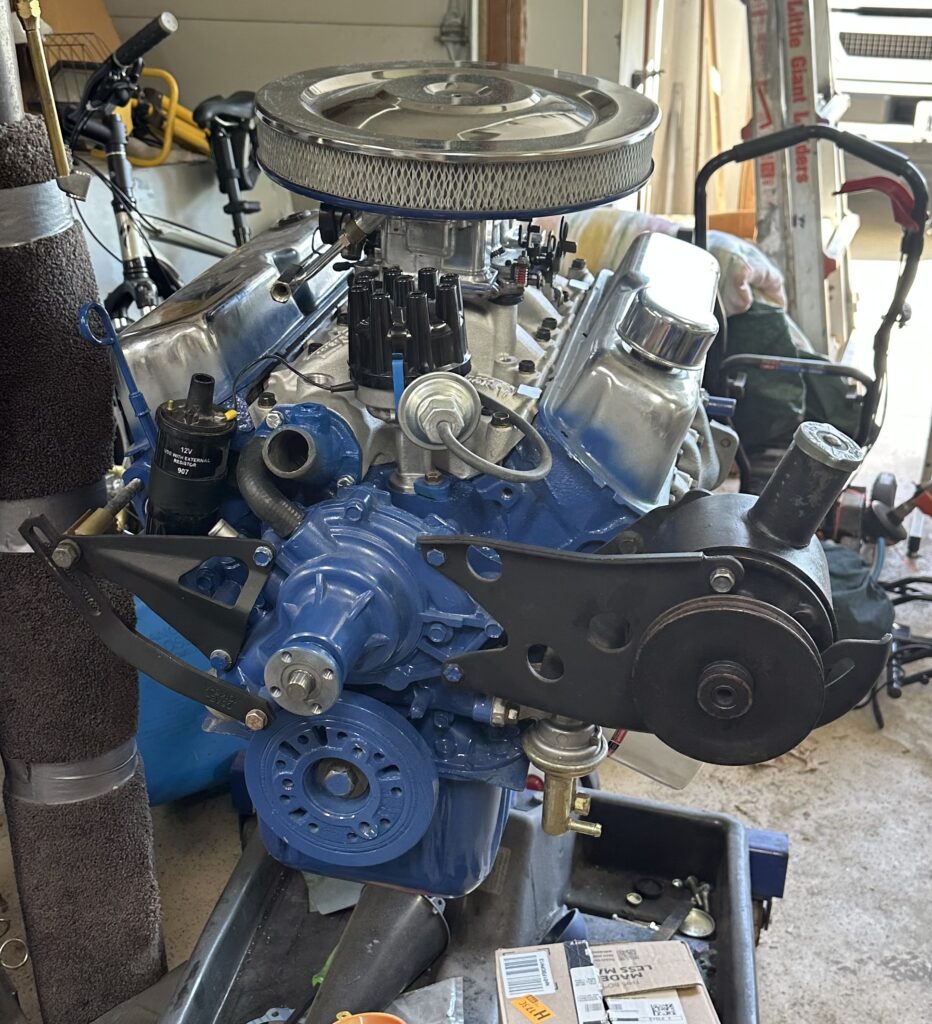
Over the past several days I got the intake manifold installed and the bolts torqued. I took a look at the valve covers. Originally I’d planned to scrap them and buy new, but more recently I’d been contemplating either stripping them of the overspray and polishing them up, or just painting them to match the engine. On close inspection, though, I confirmed my initial plan. There’s a bunch of residual RTV that suggests to me that they’re not straight, and one of them has a split where someone had over-torqued a bolt. They’re junk; I’ll keep them on as dust covers for the valve train until I pick up a new set. I really want to buy new chrome covers, but I’m going to keep talking myself out of it. Eventually, some day, someone will have a set of nice finned aluminum valve covers for sale at a price I like and I’ll scoop them up. Or not.

The carburetor is done and in place, though not attached – no studs yet. I cleaned up the air cleaner lid. Once the car is back together and I have the engine back in, I’ll measure the hood clearance and put the tallest air filter I can fit on it.

I got the thermostat housing cleaned up, painted, and installed with a new 195 degree thermostat. Today I got the distributor installed and ran a vacuum line to it. I also installed the little 90 degree elbow from the water pump to the thermostat housing, it just needs clamps. I also installed the pipe plugs in the unused intake manifold holes – a couple of 3/8 NPT plugs front and back. I left one open for the water temperature sender, and a 1/2 NPT for the heater hose.

Finally, I installed the power steering pump bracket and pump, mostly to get them out of the way of other stuff. I’m getting the garage cleaned up enough that I’ve got a little room to work, so it’s getting closer to the time when I’ll be able to get under the car and drop the transmission and driveshaft. I’ll rebuild the C4 – at 93K miles it’s probably about due. I’ll likely just replace the U-joints as well, unless they’re in really good shape.

Smoking my own tobacco

I’ve still got nearly all of my 2023 crop of Virginia and Samsun Oriental tobacco. I’ve tried it at various times and generally found it to be rather harsh and one-dimensional. Even the Cavendish I cooked over a year ago wasn’t very good at all the last time I tried some.

A few days ago, I tried a bit of some that I’d pressed back in December of ’23. I had cased the ear with water and a bit of molasses, stacked the leaves, wrapped the stack in parchment paper, and pressed it between two pieces of particle board in a shop vise for a couple of weeks. I tightened the vise every couple of days during that time to keep the pressure up. When it was done I sliced the resulting block of tobacco, and it was… horrible. I stuck it in a jar and have tried it every few months since then, and it’s slowly improving. The bowl I sampled a few days ago was actually not bad, though I couldn’t quite put my finger on what I didn’t like. Then it occurred to me… I was expecting a pure Virginia flake tobacco. This wasn’t. I had included some Samsun leaf in the stack, so what I made was almost a cigarette blend. That’s why I wasn’t wild about the taste.

I think I’m going to order two things from Whole Leaf Tobacco that I either cannot produce myself, or simply don’t want to. The one I can’t reproduce is Latakia. Once produced in Syria and now almost exclusively in Cyprus, Latakia is made by hanging Turkish tobacco leaves in a shed and burning aromatic wood and leaves in a pit in the floor of the shed. They’ll use myrtle, pine, mastic, maybe juniper. Who knows? They burn whatever is available locally – none of which is available here, not that I could keep a smoky fire going for months at a time. So I’ll but the Latakia.

The other is Perique. Used as a “condimental” tobacco both for flavor and to Ph-adjust the Virginia, Perique is both the name of a strain of tobacco, and the process that is commonly used to prepare it. This involved compressing the leaf in an oxygen-deprived environment, which allows a specific bacteria to breed and do its work fermenting the leaf. During the months-long process the leaf needs to be periodically removed, tossed, and re-compressed. Even if you do it right, I understand it to be a tedious, stinky process. I may try my hand at it later on, but for now I think I’ll buy mine.

The pressed flake I have will probably be pretty good with the addition of some Latakia and maybe a pinch or two of Perique. I’ve got some Cavendish that’s still sitting in a jar contemplating its sins, and as soon as this cold clears up I’m going to try a little of that and see if it’s learned its lesson yet.

Missouri Meerschaums

I ordered a couple of Missouri Meerschaum corncob pipes on line a couple of years back. As I recall I ordered them from Penn Valley Pipes along with a couple of clays. I’ve learned that a lot of pipe smokers like corn cob pipes for some very good reasons. For one, they are inexpensive, so one could – if so inclined – dedicate one to each blend of tobacco. Or have one for each day of the week, or whatever. They don’t require much break-in, if any. I’ve found that they don’t have a problem with condensation, and they will accept a paper Medico or Dr. Grabow filter. There’s a lot to like about them, really.

I don’t smoke them all the time, but I do use them for times when I’m not willing to risk one of my really nice pipes. Out in the garage, in the hangar, fishing, etc. If I happen to drop or lose a $15 pipe, oh well. Buy another one. Not so much the case for a really nice Peterson or Savinelli or something!

More recently I see MM has added a bunch of new pipes to their lineup. Fancy ones, Hobbit-themed churchwardens, all kinds of stuff. I don’t know that I’ll build a massive collection of cobs, but honestly — what I originally assumed were just a novelty item are really quite nice pipes that are as useful to experienced pipe smokers as they are to novices just wanting to test the waters with something cheap.

Peterson Atlantic Rusticated 221

I was in London for a couple of weeks around Easter 2022. I had not taken a pipe along with me, kind of on purpose. I did take some tobacco and a lighter, but not a pipe. I figured that if I had time, I could visit one of the pipe shops in London. With my work schedule I didn’t have the time to get to any of them while they were open. I did, however, find out that Selfridges has a James J Fox tobacconist in the store. That was a short tube ride and walk away, and they were open late, so off I went.

They had a small selection of pipes, and this one caught my eye. It being JJ Fox, in Selfridges, in London, I overpaid shamefully. That said, I love the pipe. It a favorite of mine that I use regularly. That said, it seems to have an issue with condensation and gurgling that sometimes cannot be overcome even with the Peterson “system”. I don’t know if it’s the shape or something else. (see edits below)

Rusticated Peterson Atlantic 221

Update Jan. ’24: I still like this pipe. The gurgling issue is partly the shape, and partly (the bigger part) a case of very poor drilling. The draft hole in the shank is drilled way off, intersecting around the very end of the tenon. This causes a large amount of turbulence in the airflow, and causes the moisture to condense out of the smoke. Of course there’s no way to get a pipe cleaner down there without removing the stem, so one either just deals with it or ends up with a large, soggy dottle — or both.

The peanut gallery is by now screaming, “But you just need to smoke slower!! Dry out your tobacco!” I can assure you — doing both these things will still result in a healthy gurgle about halfway through the bowl. I may do some work on the upper end of the draft hole one of these days when I’m feeling adventurous, but for now I just put up with it. I’m happy that Peterson is kind enough to hire the blind, I just wish they didn’t give them drills. 🙂

Savinelli Bing’s Favorite Limited Edition Arlecchino

There is probably only one thing that the late Bing Crosby and I have in common. I’ve got none of his talent and I don’t golf, but I love this pipe.

Savinelli makes a line of “Bing’s Favorite” pipes in various finishes. I was visiting my local shop, Ted’s Tobacco, partly to look at some of the Savinelli pipes I knew he carried. I was mostly interested in the 320KS shape, a chubby “author” bowl design. What caught my eye was this polar opposite. The Bing’s Favorite is a billiard with slim, elegant lines and a long shank. There were several in the case with various colored stems, but this one is the very unique “Arlecchino” stem that I love. When I saw pictures of the Bing’s Favorite on line I thought the stem would be a little longer than I would like; I was wrong.

I’ve smoked this pipe a number of times and it’s been wonderful. It accommodates a 6mm filter, either the standard Savinelli balsa or a cut-down Medico or Dr. Grabow paper filter. I get no gurgling or tongue bite at all. I love the size, the balance, the feel of it. I’m fond enough of it that I’m seriously considering buying a regular Bing’s Favorite in a smooth finish with the regular stem.

Savinelli Bing’s Favorite Arlecchino